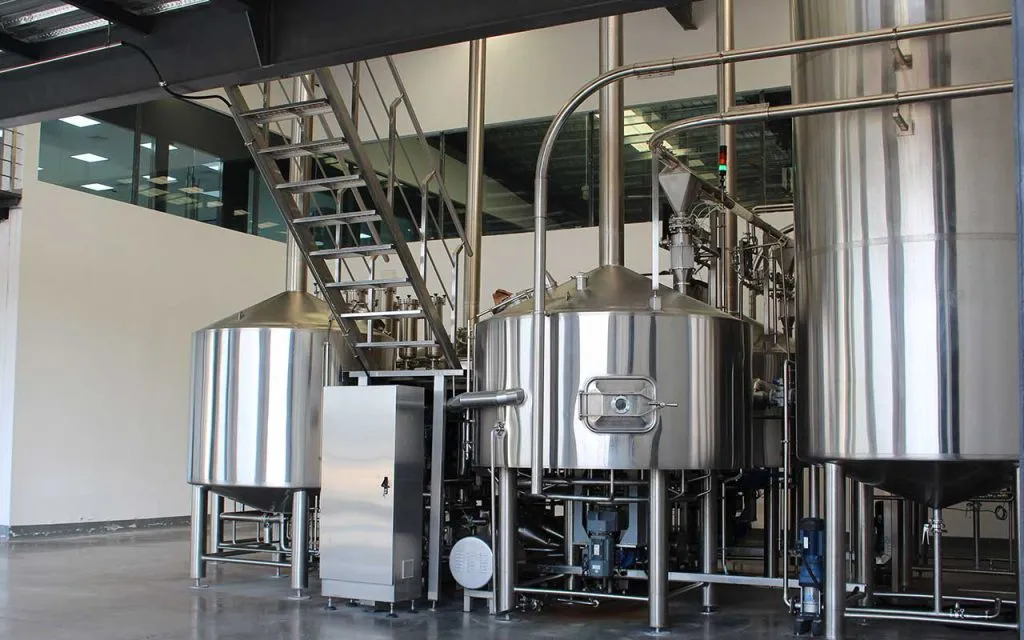
The transition from a passionate homebrewer to a commercial brewery owner is a monumental leap that requires more than just a great recipe; it requires an intricate ecosystem of industrial-grade machinery. In 2026, the craft beer market demands extreme consistency and shelf stability, meaning the “bucket and hose” days are long gone.
To produce professional-grade beer at scale, you need a coordinated “Cold Side,” “Hot Side,” and “Utility” infrastructure. This guide provides a comprehensive breakdown of every piece of equipment required to launch and operate a successful microbrewery or production facility.
1. Raw Material Handling: The Beginning of the Batch
Before you can boil wort, you must process your malt. Efficiency starts here; if your crush is inconsistent, your sugar extraction will suffer, leading to higher ingredient costs.
The Malt Mill
A professional-grade mill (usually two-roll or three-roll) is designed to crack the grain kernel while keeping the husk intact to act as a natural filter bed. Modern mills feature adjustable gaps and explosion-proof motors to comply with 2026 safety standards.
Grist Case and Augers
In systems larger than 5BBL, manually carrying grain to the mash tun is inefficient. A Grist Case stores the crushed malt, while a Flex Auger or rigid screw conveyor transports it directly into the mash tun. This reduces labor and keeps the “clean” side of your brewery free from grain dust.
2. The Brewhouse: The “Hot Side” Components
The brewhouse is where water and grain become wort. Depending on your space and budget, you may choose a 2-vessel, 3-vessel, or 4-vessel configuration.
The Mash Tun
This is where the “mash-in” occurs. It must be insulated to maintain precise temperatures for enzymatic conversion. Many 2026 models feature internal heating jackets for “step mashing,” allowing brewers to create complex malt profiles found in traditional European styles.
The Lauter Tun
Equipped with a False Bottom, the lauter tun separates the liquid wort from the spent grain.
Modern lauter tuns utilize motorized rake systems that gently “plow” the grain bed to prevent compaction and ensure a clear, efficient runoff.
The Brew Kettle
The wort is boiled here to sterilize it and extract bitterness from hops. In 2026, the industry has shifted toward Internal Calandrias or high-efficiency steam jackets to achieve a vigorous rolling boil without scorching the sugars.
The Whirlpool
The whirlpool vessel uses tangential entry to create a vortex, settling hop particulates and “trub” (proteins) into a cone in the center of the tank. This ensures that only clear wort moves forward to the fermenters.
3. Wort Cooling and Aeration
After the boil, the wort is a “biologically sensitive” liquid. It must be cooled from 212°F (100°C) to fermentation temperature (usually 50°F–68°F) as fast as possible to prevent infection and off-flavors.
Plate Heat Exchanger (PHE)
A PHE uses a series of stainless steel plates to transfer heat from the hot wort to cold water or glycol. In 2026, Two-Stage Heat Exchangers are the gold standard, using city water for the first stage and chilled glycol for the second to achieve precise “knockout” temperatures even in mid-summer.
Oxygenation Stone
Yeast requires oxygen to thrive during the initial lag phase. An in-line aeration stone injects sterile oxygen into the wort stream as it travels from the heat exchanger to the fermenter.
4. The Cellar: Fermentation and Conditioning (The “Cold Side”)
While the brewhouse makes the wort, the cellar makes the beer. This is where the product spends the majority of its life.
Conical Fermenters (Unitanks)
The modern industry standard is the Unitank—a jacketed, pressure-rated vessel with a 60° conical bottom.
Unitanks allow for primary fermentation, yeast harvesting, and carbonation all in the same vessel. They must be equipped with a PVRV (Pressure/Vacuum Relief Valve) to prevent tank implosion during cold crashing or cleaning.
Brite Beer Tanks (BBTs)
Some breweries prefer to transfer fermented beer into a dedicated Brite Tank. These flat-bottomed or dish-bottomed tanks are optimized for clarification and high-speed carbonation. Having a BBT allows your fermenters to be freed up sooner for the next batch.
5. Support Utilities: The Engine of the Brewery
These systems are often overlooked but are the most common points of failure in a new brewery.
Glycol Chiller
This is your brewery’s refrigeration hub. It pumps food-grade propylene glycol through the jackets of your fermentation tanks to maintain precise temperatures. In 2026, smart chillers can be monitored via smartphone apps to alert you if a pump fails in the middle of the night.
Steam Boiler or Electric Heating
You need a massive amount of energy to boil 300+ gallons of liquid. Most 10BBL+ systems use a Low-Pressure Steam Boiler, while smaller 5BBL systems might utilize high-kilowatt Electric Immersion Elements.
CIP (Clean-In-Place) Skid
Sanitation is 90% of brewing. A CIP skid consists of mobile tanks for hot caustic (cleaner) and acid (sanitizer). It allows you to automate the cleaning of your tanks without manual scrubbing, ensuring a sterile environment for every batch.
6. Packaging and Quality Control
Finally, the beer needs to get to the consumer.
Canning or Bottling Line
In 2026, the “Can is King.” Small-scale, automated canning lines have become affordable for microbreweries. These systems include CO2 purging, filling, seaming, and date-coding to ensure your beer stays fresh on the shelf.
Keg Washer
Even if you can most of your beer, you will still need kegs for your taproom and local bars. An automated keg washer cleans, sanitizes, and counter-pressures kegs with CO2, ensuring they are ready for a fresh fill.
7. The Critical Importance of Quality Engineering
When purchasing brewery equipment, the “cheapest” option often becomes the most expensive. A single poor weld can hide bacteria that ruins thousands of dollars of beer. A thin cooling jacket can fail under pressure, leading to a catastrophic glycol leak.
In the 2026 market, where quality is the only way to stand out, your equipment must be built to the highest international standards (CE, ASME, PED).
Recommend: Micet Brewing Equipment
If you are looking for a partner to supply your brewery’s hardware, Micet Brewing Equipment (Micet Group) is a premier global manufacturer that has defined the 2026 standard for craftsmanship. Micet provides turnkey brewing solutions that are tailored to your specific building and production goals.
Why choose Micet?
- Precision Sanitation: Their tanks feature a mirror-polish finish (Ra ≤ 0.4μm) and automatic circumferential welding, eliminating any “nooks and crannies” where bacteria can hide.
- Custom Engineering: Micet doesn’t just sell tanks; they provide 3D CAD layouts and P&ID diagrams to ensure your equipment fits your space and workflow perfectly.
- Advanced Automation: From semi-automated control panels to full PLC-integrated “Smart Brewhouses,” Micet equipment allows you to focus on the art of brewing while the machines handle the precision.
- Global Reliability: With certified pressure vessels and high-density polyurethane insulation, Micet systems are built for decades of high-performance brewing.
Whether you are starting a 5BBL brewpub or a 50BBL production facility, Micet provides the stainless steel foundation for your success.
Frequently Asked Questions (FAQ)
1. Can I start a 10BBL brewery with a 2-vessel brewhouse?
Yes. A 2-vessel system (Mash/Lauter Tun and Kettle/Whirlpool) is the most common setup for startups. It saves space and initial cost. However, it limits you to brewing only one or two batches in a single day. If you plan to brew three or four times in 24 hours (back-to-back), you will need a 3-vessel or 4-vessel system to handle the overlapping stages of the process.
2. Is steam heating better than electric for a new brewery?
For systems 7BBL and larger, steam is generally superior. It provides a faster, more vigorous boil and is much more forgiving—it is nearly impossible to “scorch” your wort with steam jackets. Electric is cheaper to install initially for very small systems (1-5BBL) but can be slower and requires much more intensive cleaning of the heating elements.
3. What is the most important utility to “oversize” when starting?
The Glycol Chiller. Many brewers buy a chiller that can handle their first four fermenters but find themselves unable to add more tanks later because the chiller is at max capacity. Always buy a chiller with at least 30-50% more cooling capacity than you currently need to allow for future expansion without having to replace your entire refrigeration system.
Would you like me to help you draft a specific equipment list or a floor plan layout based on your target production volume?