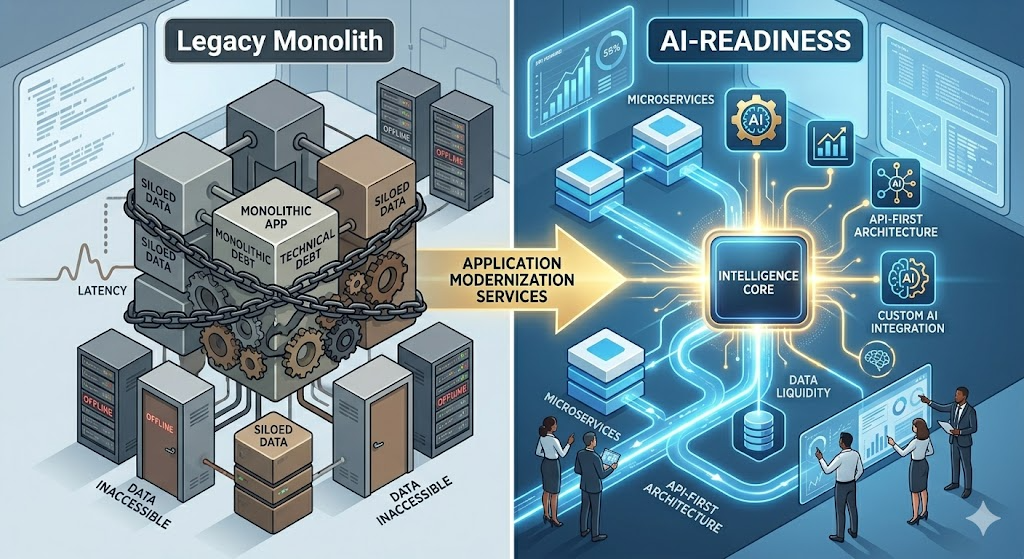
In the current fiscal year, the corporate landscape has reached a definitive tipping point. The frantic “AI gold rush” of the previous two years has matured into a disciplined architectural evolution. While many enterprises initially sought to bolt generative tools onto legacy systems, the results were often fragmented, insecure, and inefficient. As we navigate 2026, the industry consensus is clear: you cannot build a skyscraper of intelligence on a foundation of technical debt.
To truly leverage the transformative power of a custom AI development company, businesses must first address the silent anchor holding them back—their legacy software. This is why application modernization services have transitioned from a back-office IT concern to a primary pillar of global business strategy.
The Evolution of Application Modernization Services
For decades, “modernization” simply meant moving local servers to the cloud or updating a user interface. In 2026, the definition has expanded. Today, modernization is about “AI-Readiness.” It involves decomposing monolithic architectures into microservices that can be independently augmented by intelligent agents.
Modernization now focuses on three critical shifts:
- Monolith to Microservices: Breaking down rigid, single-tier applications into modular components that allow for the seamless injection of AI modules. This ensures that a failure in one AI agent doesn’t crash the entire enterprise ecosystem.
- Data Liquidity and ETL Pipelines: Ensuring that siloed legacy data is cleaned, structured, and made accessible to large language models (LLMs) and specialized neural networks. In 2026, “dark data” is the enemy of progress.
- API-First Architecture: Building robust connective tissue that allows external AI services and internal custom models to communicate without latency or security gaps. This creates a “plug-and-play” environment for future innovations.
Why Your AI Strategy Starts with Modernization
The most common failure point for digital transformation in 2026 isn’t the AI itself—it’s the infrastructure it’s forced to inhabit. When you engage in AI strategy consulting, the very first assessment usually uncovers that the company’s core applications are too brittle to handle the high-velocity data requirements of modern generative models.
Without a modernized stack, your AI initiatives will likely face “Data Constipation.” This occurs when high-performance AI models sit idle because the underlying legacy database cannot feed them information at the required speed or in the correct format. Furthermore, legacy systems often lack the telemetry required to monitor AI performance. By prioritizing application modernization, you aren’t just “fixing old software”; you are building the high-speed rails upon which your AI strategy will run.
The Role of a Custom AI Development Company
Once the foundation is modernized, the true innovation begins. A custom AI development company does not provide generic tools; they build proprietary “intelligence layers” that sit atop your modernized applications. These developers work to create models that understand your specific business logic, customer base, and historical data patterns.
In 2026, “Custom AI” means more than just a tailored chatbot. It refers to:
- Predictive Maintenance Engines: Integrated into modernized manufacturing software to predict hardware failures before they occur, saving millions in downtime.
- Hyper-Personalized UX: Modernized e-commerce platforms that use generative AI to rebuild their interface in real-time based on the specific psychological profile and purchase history of the user.
- Automated Compliance and Risk Management: Financial applications that have been refactored to include “Compliance-as-Code,” where AI automatically audits every transaction against global regulations in milliseconds.
The synergy here is vital. Modernization provides the data, while custom AI provides the insight. One without the other is a wasted investment that fails to move the needle on market share.
Strategy Consulting: Bridging the Gap
Many leaders find themselves paralyzed by the complexity of simultaneous modernization and AI integration. This is where AI strategy consulting provides the necessary North Star. In 2026, the most successful consultants are those who treat software architecture and business outcomes as the same entity.
A strategic roadmap for 2026 typically follows this hierarchy:
- Audit & Rationalization: Identifying which legacy apps should be “retired,” which should be “re-platformed,” and which are high-value candidates for “re-architecting” with AI.
- Security Integration (Zero Trust): As cyber threats become AI-driven, modernization services must bake “Zero Trust” security into the application’s core logic. This ensures that even if an AI agent is compromised, the core data remains shielded.
- The Pilot-to-Scale Framework: Moving beyond “cool demos” to enterprise-wide deployment. This requires a modernization strategy that ensures the app can handle the sudden compute load of thousands of concurrent AI-driven requests without degrading the user experience.
Technical Wealth vs. The Cost of Inaction
The cost of maintaining legacy systems is no longer just a line item in the IT budget; it is an opportunity cost that compounds daily. Enterprises that delay modernization are essentially paying a “Legacy Tax.” This tax manifests in slower time-to-market, higher security risks, and the inability to attract top-tier talent who refuse to work with archaic tech stacks.
Conversely, investing in modernization creates “Technical Wealth.” Your applications become assets that grow in value. They become more efficient, easier to maintain, and most importantly, they become a playground for the next generation of generative AI services. In the competitive landscape of 2026, technical wealth is the primary indicator of a company’s future valuation.
Scaling the Autonomous Enterprise
The ultimate objective of these combined efforts is the realization of the Autonomous Enterprise. This is a state where the “connective tissue” of the business—the workflows between departments—is managed by AI agents that live within modernized applications.
Imagine a procurement system that not only flags low inventory but automatically negotiates with three different vendors, analyzes the global supply chain risks in real-time, and presents a finalized contract for human approval. This is not science fiction in 2026; it is the reality for companies that successfully integrated application modernization services with custom AI logic. These businesses operate with a lower overhead and a higher creative output than their legacy-bound competitors.
Conclusion: The Unified Vision of 2026
As we move through the mid-2020s, the distinction between “Software Development” and “AI Development” is blurring. To be a digital leader in 2026, you must view modernization as the mandatory entry fee for the AI era.
By combining a robust modernization roadmap with expert AI strategy consulting and the technical execution of a custom AI development company, your business doesn’t just survive the shift—it dictates the pace of the entire industry. The future belongs to those whose foundations are as intelligent as the models they deploy. Stop treating AI as a “feature” and start treating your infrastructure as the ultimate competitive advantage.
FAQ
1. Why can’t I just integrate AI into my existing legacy applications?
Legacy applications are often built on monolithic architectures that lack the necessary data throughput and API connectivity for modern AI. Attempting to “bolt on” AI to these systems often results in high latency, significant security vulnerabilities, and models that cannot access the real-time data they need to function accurately.
2. How do application modernization services reduce the cost of AI development?
Modernization simplifies the underlying codebase and standardizes data formats. When your infrastructure is clean and modular, a custom AI development company spends less time on data “plumbing” and more time building high-value features. This significantly reduces development hours and long-term maintenance costs for your AI initiatives.
3. What is the role of AI strategy consulting in the modernization process?
Strategy consulting ensures that you don’t modernize in a vacuum. Consultants analyze your business goals to determine which applications need the most urgent attention based on their potential for AI augmentation. This prevents wasted expenditure on low-value software and ensures your technical roadmap directly supports your revenue objectives.
4. Will modernizing my applications require a complete system shutdown?
Not with modern “strangler” patterns or phased migration strategies. Modernization services in 2026 focus on incremental updates, where specific functionalities are moved to new architectures one at a time. This allows your business to remain operational while gradually shifting the load to a more efficient, AI-ready foundation.
5. How does a custom AI development company ensure my data remains secure during this shift?
A reputable company will implement “Security by Design.” By modernizing your apps, they can move from perimeter-based security to “Zero Trust” architectures. This ensures that as your custom AI processes sensitive data, every interaction is encrypted, authenticated, and logged, meeting the stringent compliance standards of 2026.