Railways have always been among the most complex transportation systems ever built. Thousands of trains travel simultaneously across vast networks, carrying millions of passengers and enormous quantities of freight every day. Behind the scenes, a sophisticated system ensures that everything runs smoothly, safely, and efficiently. At the heart of this system lies the rail operating centre.
A rail operating centre acts as the brain of a railway network. It is where critical decisions are made, train movements are monitored, disruptions are handled, and real-time data is analyzed to maintain smooth railway operations. Without these centers, modern railway systems would struggle to function at the scale and efficiency people rely on today.
Understanding how these centers operate reveals just how advanced modern rail management has become. From powerful digital monitoring systems to teams of skilled controllers working around the clock, the rail operating centre plays a vital role in ensuring that trains arrive safely and on time.
The Core Purpose of a Rail Operating Centre
A rail operating centre is designed to oversee and manage the entire railway network from a centralized location. Rather than relying on multiple smaller signal boxes scattered across a region, modern rail systems consolidate operations into a single high-tech facility.
The primary purpose of the center is real-time control and coordination of rail traffic. Every train movement, signal change, and track status update is monitored from this hub.
Key responsibilities include:
- Monitoring train movements across the network
- Controlling signals and track switching systems
- Managing delays and disruptions
- Coordinating maintenance teams
- Ensuring passenger safety
- Communicating with train drivers and station staff
These tasks require advanced technology combined with highly trained professionals who can react quickly to unexpected situations.
A well-designed rail operating centre can manage hundreds of trains simultaneously, ensuring that schedules remain reliable and safe.
Evolution of Railway Control Systems
Railway control systems have changed dramatically over the past century. Early rail networks relied on manual signaling and local control boxes placed near tracks and stations. Each signal operator controlled only a small section of railway, and communication between locations was limited.
As railway networks expanded, this decentralized approach became inefficient.
The evolution of railway management can be divided into several major stages:
Early Mechanical Era
- Manual levers controlled signals and track switches
- Signal boxes located at nearly every major junction
- Communication relied on telegraphs and early telephones
Electromechanical Period
- Power-operated signals replaced manual systems
- Larger control panels allowed operators to manage multiple tracks
- Early automation improved safety
Digital Control Era
- Computer-based systems replaced analog control panels
- Real-time monitoring became possible
- Network-wide coordination improved dramatically
Modern Centralized Management
- Large rail operating centres replaced hundreds of local signal boxes
- Integrated digital dashboards show the entire network in real time
- Artificial intelligence and predictive analytics assist decision-making
Today’s railway networks depend heavily on these centralized control systems to maintain efficiency.
Key Technologies Used Inside a Rail Operating Centre
A modern rail operating centre is packed with advanced technology designed to manage complex transportation networks.
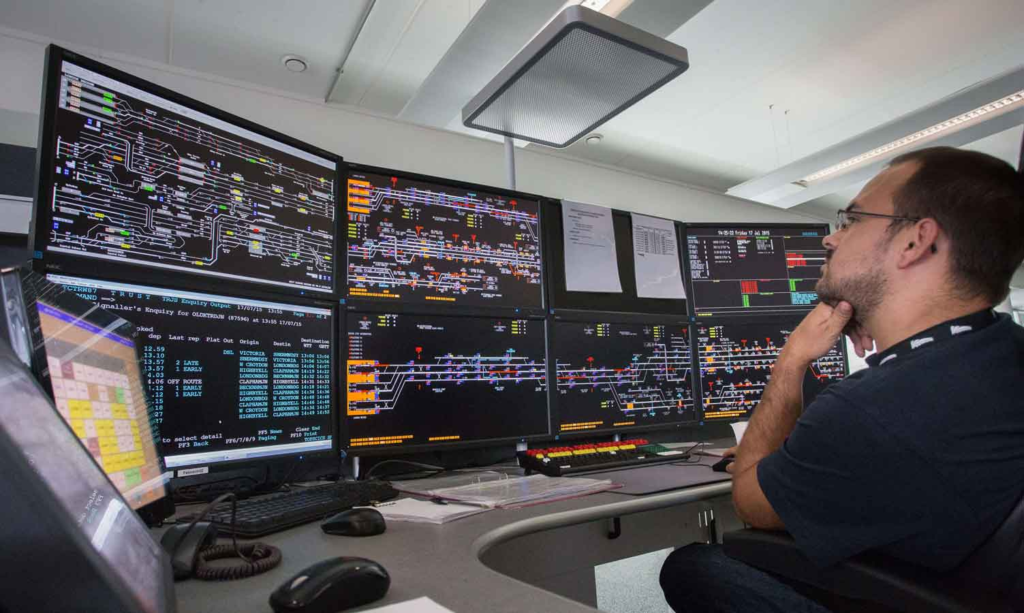
The main control room typically features massive display walls showing live network maps, train locations, weather updates, and infrastructure status.
Several core technologies power these centers.
Integrated Train Control Systems
These systems allow operators to view and manage every train across the network. They display:
- Train speed
- Current location
- Signal status
- Platform assignments
- Route settings
Controllers can quickly adjust routes or signals to prevent conflicts between trains.
Real-Time Data Monitoring
Sensors across the railway network send constant updates to the rail operating centre. These sensors monitor:
- Track conditions
- Signal performance
- Power supply systems
- Train positions
- Weather impacts
This data allows controllers to detect problems immediately.
Automated Signaling Systems
Modern signaling systems use digital communication between trains and infrastructure. Many networks now use:
- Automatic Train Control (ATC)
- European Train Control System (ETCS)
- Positive Train Control (PTC)
These technologies improve safety by automatically enforcing speed limits and preventing collisions.
Communication Networks
Reliable communication is essential. Rail operators use specialized radio systems to stay connected with train drivers, station staff, and emergency teams.
A rail operating centre typically manages thousands of communication channels simultaneously.
How Daily Operations Are Managed
Inside a rail operating centre, operations run continuously. Teams work in shifts to ensure 24-hour coverage.
Controllers monitor large screens displaying the railway network. Each operator is responsible for a specific region or set of tracks.
Typical daily operations include:
Train Scheduling
Controllers ensure trains follow planned schedules while adjusting routes to handle unexpected delays.
Traffic Flow Management
Operators prevent congestion by spacing trains appropriately and managing track usage.
Incident Response
If a train breaks down or a signal fails, controllers coordinate emergency procedures and reroute other trains.
Passenger Information Updates
Accurate travel information is sent to stations, mobile apps, and digital boards.
Maintenance Coordination
Maintenance teams often need temporary track access. Controllers schedule these activities to minimize disruption.
Through careful coordination, the rail operating centre ensures smooth network performance.
The People Behind the Control Screens
Technology alone cannot manage a railway system. Skilled professionals working inside the rail operating centre play a critical role.
Several specialized roles exist within these centers.
Rail Traffic Controllers
These professionals oversee train movements and ensure safe spacing between trains.
Signaling Operators
They manage signal systems and track switching equipment.
Incident Managers
When disruptions occur, these experts coordinate response strategies and recovery plans.
Data Analysts
They monitor operational data and identify patterns that could improve efficiency.
Communication Coordinators
These staff members maintain contact with drivers, station teams, and emergency responders.
Training for these roles is rigorous. Staff must understand railway infrastructure, safety procedures, and advanced control systems.
Advantages of Centralized Rail Control
The shift toward centralized management through a rail operating centre has transformed railway operations.
Several benefits have emerged.
Improved Safety
Centralized monitoring allows controllers to detect potential conflicts before they become dangerous.
Faster Response to Problems
When issues arise, decision-makers are already gathered in one location, allowing quicker solutions.
Higher Network Efficiency
Central coordination reduces congestion and improves scheduling.
Better Passenger Experience
Real-time updates help passengers stay informed about delays or changes.
Reduced Infrastructure Costs
Replacing hundreds of small signal boxes with one rail operating centre lowers maintenance expenses.
These advantages make centralized control essential for modern rail systems.
Managing Disruptions and Emergencies
Railway disruptions can occur at any time. Severe weather, equipment failures, and unexpected obstacles can all affect train operations.
When a disruption happens, the rail operating centre becomes the command center for response efforts.
Controllers immediately analyze the situation using real-time data. They may:
- Stop affected trains
- Reroute traffic
- Dispatch maintenance teams
- Inform passengers and staff
- Coordinate with emergency services
Advanced simulation tools help teams predict how disruptions might spread across the network.
Quick decision-making from the rail operating centre helps minimize delays and restore normal operations as quickly as possible.
Integration With Smart Transportation Systems
Modern transportation networks are becoming increasingly interconnected. The rail operating centre now plays a role beyond traditional rail management.
Many centers integrate with:
- Urban metro systems
- Bus networks
- Airport transportation
- Freight logistics hubs
By sharing real-time data, transportation providers can coordinate schedules and reduce delays.
Smart city technology is also influencing railway operations. Traffic management systems, weather forecasting tools, and passenger data platforms can all connect with the rail operating centre to improve overall mobility.
Cybersecurity and Data Protection
Because modern rail networks rely heavily on digital systems, cybersecurity has become a top priority.
A rail operating centre handles vast amounts of sensitive operational data. If systems were compromised, train safety and passenger security could be at risk.
Rail operators therefore implement strict protections, including:
- Encrypted communication networks
- Multi-layer authentication systems
- Continuous system monitoring
- Isolated control networks
- Emergency backup systems
Cybersecurity teams constantly monitor systems to detect unusual activity.
Protecting the digital infrastructure of the rail operating centre is just as important as maintaining the physical railway.
The Global Expansion of Rail Operating Centres
Many countries are investing heavily in centralized railway management.
Major rail networks in Europe, Asia, and North America are replacing older signal boxes with modern rail operating centre facilities.
Examples include:
- Large national control hubs overseeing thousands of kilometers of track
- Regional centers managing metropolitan commuter rail systems
- Dedicated freight network control centers
These facilities often cost hundreds of millions of dollars to build but significantly improve long-term network performance.
As railway networks expand and become more complex, centralized management becomes increasingly necessary.
Future Innovations in Rail Network Control
Railway technology continues to evolve rapidly. The rail operating centre of the future will likely include even more advanced systems.
Several innovations are already emerging.
Artificial Intelligence for Traffic Optimization
AI systems can analyze massive amounts of data to predict congestion and recommend optimal train routing.
Predictive Maintenance
Sensors installed on tracks and trains send data to the rail operating centre, allowing maintenance teams to fix issues before failures occur.
Autonomous Train Operations
Driverless trains are already operating in some metro systems. Central control systems will play a crucial role in managing these fleets.
Digital Twin Technology
Digital replicas of railway networks allow controllers to simulate different scenarios before implementing changes in the real system.
Enhanced Passenger Data Integration
Future systems may incorporate real-time passenger flow data to improve scheduling decisions.
These advancements will make the rail operating centre even more powerful in managing complex transportation networks.
Why Rail Operating Centres Matter More Than Ever
Railways remain one of the most efficient and environmentally friendly forms of transportation. As cities grow and demand for sustainable travel increases, rail networks will continue expanding.
Managing these networks requires precise coordination, advanced technology, and constant monitoring.
The rail operating centre provides exactly that.
By bringing together powerful digital systems and skilled professionals, these centers ensure that railways remain safe, reliable, and efficient.